![Exploring Invertebrates: 10 Picture Books to Introduce Animal Characteristics [ep. 9]](https://www.naturallyteaching.com/wp-content/uploads/2024/07/exploring-invertebrates-books-header-300x200.png)
Science
Frogs and Toads Together: Why do Amphibians Group Up?April 11, 2025

An elementary teacher science blog
Investigating a reptiles and amphibians list of local species can be a great way to learn about diversity in your ecosystems as well as the way energy moves through food chains. May is a fantastic time to do this since the reptiles and amphibians have come out of their winter sleep and are starting to lay eggs. Let’s take advantage of the season and investigate our amazing herps!
In this episode, we’ll talk about activities to investigate a reptiles and amphibians list that are paired with Next Generation Science Standards for grades 2nd and 5th. I’ll share the standard that inspired the activity, how the activity relates to reptiles and amphibians, and descriptions of how to use the activity with your learners.
The following standards are paired with activities about a reptiles and amphibians list:
[0:00]
Teaching elementary-aged children is a rewarding experience, but as educators and parents, finding the time and resources to create engaging lessons can be a challenge. That's where this podcast comes in. Welcome to Naturally Teaching Elementary.
I'm Victoria Zablocki, a certified elementary teacher turned outdoor educator. With over a decade of experience coaching teachers on effective teaching methods, I'm passionate about teaching the whole child with authentic and place-based experiences in school and home settings. Join me as we explore strategies for teaching with practical teaching tips, insightful interviews, picture book reviews, and more.
So let's grow together. Hey, everybody. Welcome back to the Naturally Teaching Elementary Podcast. My name is Victoria Zablocki and I'm your host. If you listened to last week's episode, episode 70: How Are Reptiles and Amphibians Different? First and Fourth Grade NGSS Activities, you heard a couple ideas of activities to introduce the differences between reptiles and amphibians to first and fourth graders. This week, we'll continue the theme of herps, but more specifically, we'll focus on a reptiles and amphibians list in connection to second and fifth grade Next Generation Science Standards. Second and fifth grade standards focus more on animal habitats and habitat components, and May is a great time to investigate where reptiles and amphibians live.
In this episode, I'm going to describe reptiles and amphibians list activities for grades second and fifth. For each activity, I'll share the Next Generation Science Standard that inspired that activity, as well as the scientific phenomenon that the activity helps explain. And make sure that you listen through to the end of the episode because even though I've paired these activities to particular standards, you may find yourself inspired to use a similar concept for your curriculum or even use the same activity for a different grade.
Also, if you're new to taking your students outside for learning, check out episode 6: 5 Outdoor Education Safety Tips for Teaching Outside for suggestions to make teaching outside easier. Now, let's get into these reptiles and amphibians list activities.
[1:55]
So for second grade, the Next Generation Science Standard that I pulled was 2-LS4-1: Make observations of plants and animals to compare the diversity of life in different habitats.
So for second grade, I would suggest doing a turtle investigation. Although turtles come from the same family, not all turtles are made equal. Some turtles live in ponds, others live in rivers or oceans, and some even live on land.
A quick nature note about turtles, you can tell a lot about turtles and where they live just by looking at their bodies. When looking at a turtle, how much webbing there is on their feet and their shell shape can tell you where they live. Turtles that live in a body of water that have currents like a river and ocean will have very webbed feet or flippers.
A turtle that lives in still water such as a marsh or a pond have a smaller amount of webbing, and a turtle that lives on land won't have very much webbing, but will have club-like feet instead. Just as an extra side note, there's also a difference between tortoises and land or terrestrial turtles. Terrestrial turtles have the slightest of webbing between their toes and flexible ankles, whereas tortoises have stump-like feet with thick fused ankles.
As I mentioned, you can look at the shell to help determine where a turtle lives. A very dome-shaped shell can be found on a land turtle and helps them stay safe from predators. The dome shape gives terrestrial turtles more room to fully retreat into their shell.
Some land turtles, like box turtles, can actually close up their shells to keep themselves safer. And then slick, short shells can be found on aquatic turtles as they provide less drag while they're swimming in the water to avoid predation. So with that background information, provide your class a list of local turtles to investigate.
You can have them look closely at their bodies to try to predict where they think the turtle lives. And you could provide them the information I just shared with you, briefly talk about camouflage and the benefits of coloration so they can consider which ecosystem they think they would blend in with. And also give them a chance to research one of the species while working in small groups.
If I were making a turtle list for Michigan, I would include Painted turtles, Blanding’s turtles, Eastern snapping turtles, Spiny softshell turtles, Common map turtles, Wood turtles, and Eastern box turtles. This list includes a mixture of pond, river, and terrestrial turtles. After giving your learners their list of turtles, set them loose to learn more about the species that they choose. Where does it live? What does it eat? Does it swim? How does it protect itself from predators?
Whatever questions you want them to answer, make sure each group is answering them so you can do a one-to-one comparison between the different species later. Once your small groups have answered these or other questions, work together as a whole class to do some comparing.
Start with turtles that live in the same ecosystems and create a double bubble chart or Venn diagram as a whole group. What do they have in common? What is unique about them?
This will help your learners see that although these turtles live in the same habitat, if you will, they look and behave differently. Once you've compared turtles that live in the same ecosystem, compare turtles that live in different ecosystems. Do they think they will have anything in common or do they think everything will be different?
Create another double bubble chart or Venn diagram for each of these pairings and talk about the diversity they're noticing. This turtle study will help your learners see that even though all turtles are turtles, they can specialize and live in different places depending on what they need. It can also enlighten your learners to the fact that even though some turtles live in the same space, they may interact with that space in a different way.
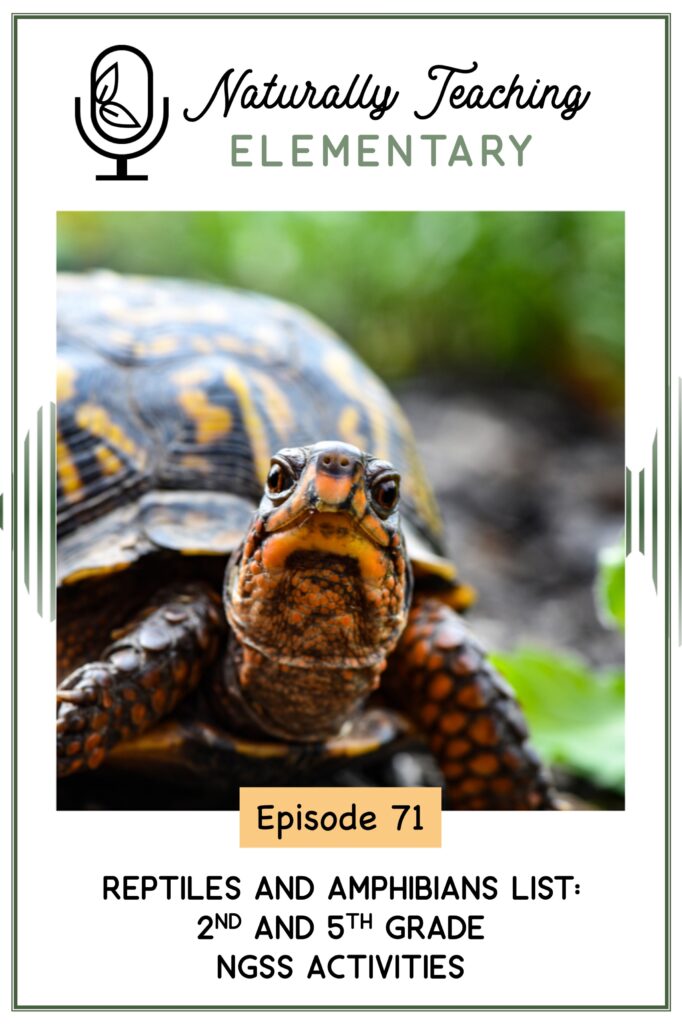
Great conversations about animal diversity can come from this experience. And also, who doesn't love turtles, am I right? Make sure to take a look at the cover for this episode because I picked the cutest little eastern box turtle. He looks like a smiling old man.
[5:33]
For fifth grade, the Next Generation Science Standard that I pulled was 5-PS3-1: Use models to describe that energy in animals' food, used for body repair, growth, motion, and to maintain body warmth was once energy from the sun.
So for fifth grade, I'm going to suggest a food chain flag tag game. So the focus of this game will be to show how the energy flows from producers to consumers. In theory, you've already talked about photosynthesis this year, and how plants produce their own food from the energy from the sun, amongst other things.
With this background knowledge, your learners will be able to surmise that the plants in this game have already made their food and have the energy of the sun to pass on to animals that eat them. So I typically try to shy away from a lot of prep since I know time is in short supply for teachers and homeschool parents, but this game will be a great illustration of energy flow in a food chain. So in my opinion, this prep is worth it.
So to prep for this game, you're going to try to get your hands on flag tag belts. If you have access to flag tag belts, these can be super helpful when playing this game. Alternatively, you could use clothes pins.
The flags or clothes pins will represent the energy of the organism that's running around. You'll also want to have a way to designate which organism is which, something like colored armbands, bandanas, or headbands. In this food chain model, we're going to have a producer, typically designated by green, a primary consumer, designated by a color that represents that animal, and a secondary consumer, also designated by a color that represents that animal.
Since we're focusing on activities to investigate a reptiles and amphibians list, I would suggest having a reptile or amphibian in the food chain. You could create a few different sets of food chains based on ecosystem if you'd like, or you could just have a few different sets that are themed around a reptiles and amphibians list. As an example, here in Michigan, I could have algae be my producer designated by green, Green frog tadpoles designated by brown as our primary consumer, and Painted turtles designated by red to be the secondary consumers.
Another example here in Michigan could be leaves designated by green, caterpillars designated by brown, and Five-lined skinks designated by blue. Yet another example here in Michigan could be Wild strawberry designated by green, slugs designated by gray, and Brown snakes designated by brown. Alternatively, if you don't have the materials to assign different colors to your players, you could use masking tape to put a number zero for plants, a number one for the primary consumers, and a number two for secondary consumers on their backs.
To play this game, you'll want to bring the learners outside and show them the play space. You'll want to pick a large open space that doesn't have obstacles like a soccer field or a track field, mark the boundaries with cones, ropes, or use pre-designated boundaries like chalk lines. After showing them their space, you'll assign about half of the learners to be plants and give them a green designator or a number zero, and a flag tag belt with two flags or use two clothespins.
If you choose to use clothespins, make sure it's easily accessible on the bottom of their shirt, so that way they can be grabbed but not choked by the shirt when pulled. Then have about three-quarters of the remaining learners be your primary consumers with a particular color or the number one, and a flag belt with one flag or use one clothespin. Then have the remaining learners be secondary consumers with a particular color or the number two, and a flag tag belt with zero flags or zero clothespins.
For this game, the flags and clothespins represent the energy that's passed from organism to organism. The reason you have different number of flags to start the game is because of the way that energy moves through the different trophic levels. If you look at the energy pyramid, each time energy moves to a new trophic level, only 10 percent of the energy is transferred.
Your plants are starting with two flags because they get 100 percent of the energy from the sun. Your primary consumers don't have a tenth of the energy using this flag situation, but they're starting with one flag which is less than the producer, but it's more than the secondary consumer. To play this game, have your learners spread out in the play space.
When you say go, the producers are running for their lives. They don't have anyone to grab flags from. They're just trying to stay away from the primary consumers and keep the flags on their belts. That's it. That's their whole gig.
The primary consumers are going to be very busy. They're trying to grab flags from the producers, while also trying to keep the secondary consumers from grabbing their flags. And the few secondary consumers that you have playing are just focused on trying to grab the flags of the primary consumers. That's their whole gig.
When a child gets a flag from another child, they can put the flag on their belt to represent the flow of energy through the trophic levels. When a producer or primary consumer runs out of flags, they come to a designated space out of bounds to wait for another round. You can continue play for a certain amount of time, or until all of the players have lost their flags except for the secondary consumers.
If you want to redistribute the flags and change roles, you could have any child that was a producer in the first round become a consumer, and any consumer from the first round could be a producer. When all of your rounds are complete, have a conversation about what happened.
How did the energy move during the game? Where did the energy come from originally? What do you think happens to the energy in nature after a secondary consumer? What happens to the energy if one of the animals dies before it can be eaten?
If you wanted to add a decomposer into the experience, you could give your dead organisms on the sidelines or the people that lost all their flags, a picture of a worm, fungus, beetle, or other decomposer to represent the return of remaining energy and matter to the earth. Wrap this experience up with pictures of the food chain and have your learners order the experience they just had. We could use my first example from earlier.
With that, I would have a picture of the sun, algae, a tadpole, and a Painted turtle. The learners would then have to work together to put these organisms in order of energy flow. And from their experience, they should be able to explain that the energy comes from the sun, the algae makes its own food from that energy, then the tadpole eats the algae, taking on that energy, and then the Painted turtle eats the tadpole, taking on that energy. If you wanted to extend the food chain, you could include a tertiary consumer such as a raccoon and a decomposer like a worm.
[11:56]
So in a nutshell, today we talked about activities including a list of reptiles and amphibians for second and fifth grade. For second grade, we talked about conducting a turtle study, and for fifth grade, we talked about playing an energy transfer flag tag game.
So thanks for taking time to listen today. I know you're busy and I truly appreciate the time you take to tune in. If you have any questions, wonderings, or reptiles and amphibians list activities that you use, get a hold of me on Instagram at naturally.teaching, or you can email me at victoria@naturallyteaching.com.
And don't forget to check out the show notes for this episode at naturallyteaching.com/episode71 for all those links that I mentioned. So thanks again for joining me today. And until next time, keep exploring, keep learning, and keep naturally teaching.
Thank you so much for tuning in to today's episode of the Naturally Teaching Elementary Podcast. I hope you found it informative, inspiring, and full of actionable insights to enhance your teaching journey. Connect with me on social media for more updates, science tidbits, and additional resources.
You can find me on Instagram and Facebook at naturally.teaching. Let's continue the conversation and share our passion for teaching elementary age children together. Don't forget to visit my website at naturallyteaching.com for all the show notes from today's episode.
If you enjoyed today's episode, please consider leaving a review on your favorite podcast platform. Your feedback helps me improve and reach more educators like you. Thank you again for listening, and until next time, keep exploring, keep learning, and keep naturally teaching.

0