![Exploring Invertebrates: 10 Picture Books to Introduce Animal Characteristics [ep. 9]](https://www.naturallyteaching.com/wp-content/uploads/2024/07/exploring-invertebrates-books-header-300x200.png)
Science
Frogs and Toads Together: Why do Amphibians Group Up?April 11, 2025

An elementary teacher science blog
Affiliate disclosure: As an Amazon Associate, I may earn commissions from qualifying purchases from Amazon.com. This is at no extra cost to you. If you’d like to learn more, check out my disclaimers page.
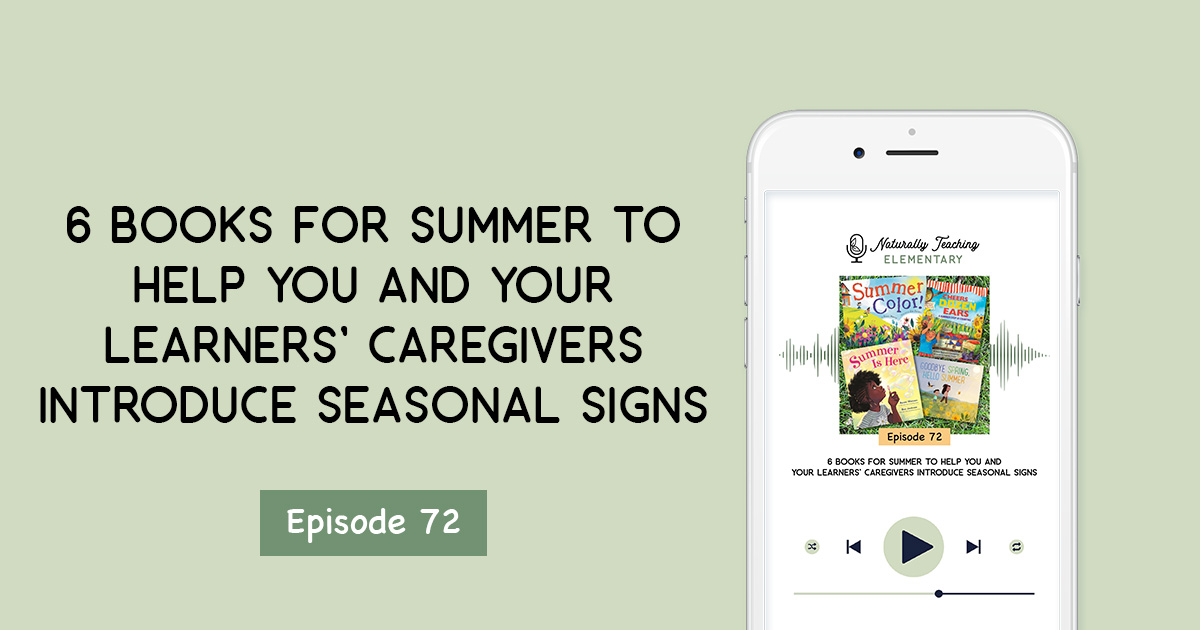
Summer is almost here and with it comes a change in weather and longer hours of daylight (and summer break!). Books for summer could be just what you need to connect school to home during this break – and I’ve got you covered!
In this episode, I share 6 books for summer to help you and your learners’ caregivers introduce seasonal signs, ideas for people to explore nature, and crops available for harvest. Listen in to discover some amazing picture books to share with families this summer!
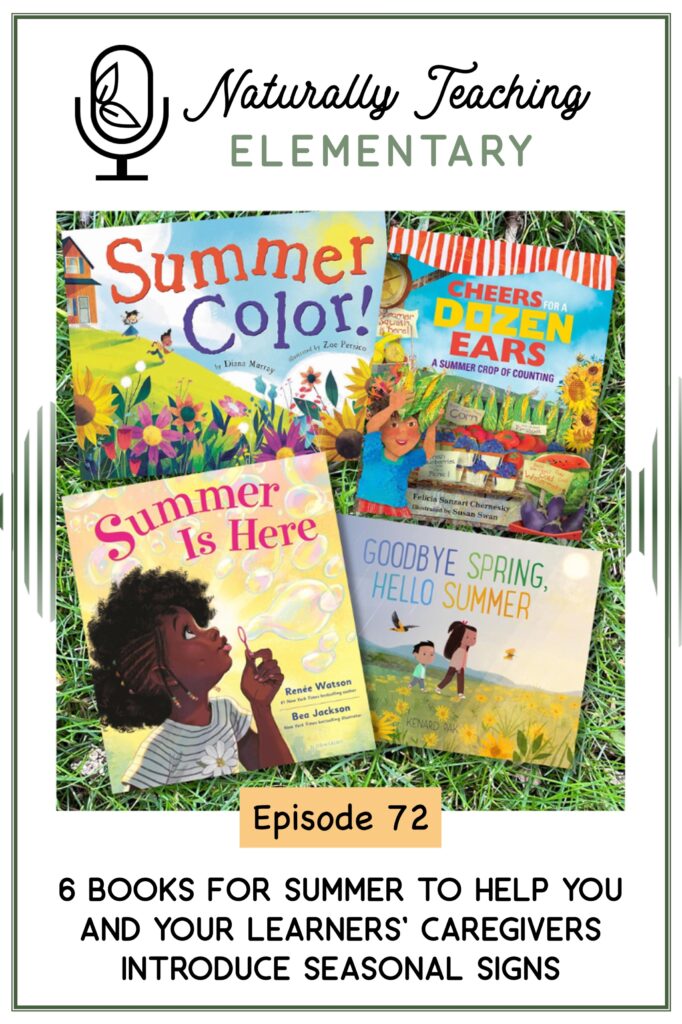
Books for summer covered in this episode include:
Want to view all of these books in one place? Check them out here!
Extra books about seasons touched on in this episode include:
Affiliate Disclosure
I only endorse things that I’ve personally used, come highly recommended by trusted peers, or I’ve done extensive research on. As an Amazon Associate, I may earn commissions from qualifying purchases from Amazon.com. This is at no extra cost to you, the commission is covered by the company.
I am recommending products that I think will be genuinely helpful and useful, and not because of the small commissions that I receive. Please only purchase items if you believe that they will help you achieve your educational goals. If you’d like to learn more, check out my disclaimers page.
[0:00]
Teaching elementary-aged children is a rewarding experience, but as educators and parents, finding the time and resources to create engaging lessons can be a challenge. That's where this podcast comes in. Welcome to Naturally Teaching Elementary.
I'm Victoria Zablocki, a certified elementary teacher turned outdoor educator. With over a decade of experience coaching teachers on effective teaching methods, I'm passionate about teaching the whole child with authentic and place-based experiences in school and home settings. Join me as we explore strategies for teaching with practical teaching tips, insightful interviews, picture book reviews, and more.
So let's grow together. Hey everybody, welcome back to the Naturally Teaching Elementary Podcast. My name is Victoria Zablocki and I'm your host.
So it's almost time, and for some of us it's already time, but it's that time of the year when school is letting out and we can take a breath. Whether you're a homeschool family getting ready for a couple of weeks off, or a school teacher that follows an academic year getting ready for a few months off, or a teacher that follows a balanced calendar getting ready for an extended break, whoever you are, you deserve the start to summer.
But not only is it a great opportunity for a break, it's also a great opportunity to connect learning to home. And I've got a great way for you to encourage your learners to connect with science at home this summer and I bet you can't guess what it is… it's picture books.
I've got a list of six books for summer for you today. And if you've listened to my other episodes about picture books, I'm sure that you've caught on to the fact that I'm very passionate about teaching science concepts with the help of children's literature. And for good reason.
Research has shown that integrating science and literacy has many benefits, including saving teachers time in their schedule, improved attitudes of children towards science, better overall performance in reading and science, and so many more. For more information about benefits and methods for integrating science and literacy, check out my blog post “Teaching with Books: How to Integrate Science and Literacy for Elementary Classrooms.” So let's get into it.
[2:04]
So book number one is Goodbye Spring, Hello Summer by Kenard Pak. And this book is about a little girl who takes a walk and discovers that spring is fading and that there are new signs of summer. She notices that the grass is green and the rain makes it grow tall.
She notices that shadows are longer and that there are butterflies flying in and out of the sunlight. She sees orioles and bluebirds and a patch of wildflowers, including cosmos, marigolds, zinnias, and black-eyed Susans. And she walks through the forest and she notices chickadees, trees, logs, and the warm air. At the end, she meets up with her brother and they make their way back home.
This book is simple, can be used for children of all ages, but typically like early childhood age, and it shows a variety of summer seasonal signs coming in, both through words and in pictures. It starts with the little girl saying “hello” to something, and then it says “hello” back and says what it's doing.
And all of this provides that opportunity to understand what's happening in summer versus what's happening in spring and how the seasonal signs change. This is a great book for now because we're starting to see spring fading and summer really coming into its own. So this is like a nice transition book from spring to summer and could really get your families talking about the differences between the school year and the seasons that take place then and summer when they get their break.
If you really like this book, Kenard Pak actually has three more to connect the seasons, including Goodbye Summer, Hello Autumn, Goodbye Autumn, Hello Winter, and Goodbye Winter, Hello Spring.
[3:38]
Book number two is Summer is Here by Renee Watson, illustrated by Bea Jackson. This book shows how signs of summer lead to wonderful social experiences between girls. The main character starts by waking up to sun and enjoying seasonal fruits for breakfast, including mangoes, strawberries, and blackberries. Then she goes swimming with her friends and jump roping. She also visits with family at a park and enjoys the shade of the trees.
Her family cooks food on the grill and her friends throw water balloons at each other. She also gets ice cream from the ice cream truck, and she blows bubbles and pops them. She says goodbye to the day as she enjoys a summer breeze blowing through her open window.
This book is a great option for getting children fired up about what they can do during the summer. To first connect with young children, you really have to show them how something affects them. Watson shares some summer signs that make the social experiences happen and you can help point those out to your early readers.
Then that shows them how they can relate to that season. You can also look closely at the illustrations by Jackson to find signs of summer. Also, Jackson does an amazing job illustrating people of a variety of colors and body shapes, representing more of our population to help children see themselves in the book.
[4:53]
Book number three is When Summer Comes: Exploring Nature in Our Warmest Season by Aimee M. Bissonnette, illustrated by Erin Hourigan. This book is similar in its respect to highlighting what people can do in the summer time.
And there's a family in this book that is exploring nature and enjoying all of the things when it's warm. The family in the story goes to ballgames markets, and they gather their gear to explore the wild. While they're out there, they see woodpeckers, Black bears, elk, and deer.
They climb over decomposing logs that hold termites, beetles, mushrooms, and tiny plants. They visit the ocean and look for whales, dolphins, and tide pools. They camp near a snow-covered mountain in a field with wildflowers and butterflies.
And while they hike in the mountains, they see marmots, picas, and mountain goats. And they bike, they visit swimming holes, they kayak, and they watch bats catch mosquitoes out of the air. This book really shows the variety of exciting things that people can do in the summer time.
And one cool thing about this book is it's based in the south or based closer to mountains and oceans than where I am. I'm in Michigan, so this book isn't overly applicable to my students, but it could be great for you if you're in a different part of the country.
If you're in a southern state or a coastal state, this could be a great book for your families to enjoy together, because that could give them some ideas of things that they could do as a family. Horrigan does a great job illustrating families of different colors in this book as well.
[6:22]
Book number four is Summer Song by Kevin Henkes, illustrated by Laura Dronzek. Henkes compares signs of summer, such as the sun, to flowers, and flowers as little suns of different colors. Henkes compares summer to a song of green, including a song of leaves, trees, weeds, grass. He shares about the wind blowing through grass, which sounds like music, and so do the air conditioners, the fans, the sprinklers, the lawnmowers, the birds, the rain and thunder, and the bugs.
Then he also brings in fireflies and how they sing to each other without sound. And he really encompasses this metaphor of the summer song, where it's warm, it's hot, it's hotter, or it's cool in the shade, and the hose makes it cool. He's trying to give all of these different feelings and all of these different pieces that make it feel like a song.
This book is a very simplistic look at summer seasonal signs, but he really does a nice job of showing how the summer isn't just about the heat and the green, it's about all of these different things that are alive and make all of these sounds, and that sound is the song of summer. And it's the season of energy and the season of life. If you really like this book, you could also check out Henkes' other titles, including In the Middle of Fall, Winter is Here, and When Spring Comes.
But again, with its simplicity, I would suggest this book for early childhood learners in addition to all these other books that he has written that are about the seasons.
[7:54]
Book number five is Summer Color by Diana Murray, illustrated by Zoe Persico. And this is a rhyming book that highlights summer signs, but they match them to different colors. For yellow, they illustrate sunflowers and lemonade. For red, they share ice pops. Gray are the clouds. Green are the treetops. Pink are the wildflowers. White are the egrets and the waterfalls. There's purple picnic blankets. There's a brown fence. There's a shed that's painted black. And then there's some orange towels. And then there's the blue sky. And at the very end of the book, they picture a rainbow to be able to bring all the colors back together.
Not only are these signs of summer, but there's also some other signs that aren't referenced by a particular color. So some of the signs that Murray highlights are the heat, sparrows chirping, peaches, shade, fawns with does, and a variety of different animals that are pictured and also mentioned in the text, including foxes, cardinals, raccoons, frogs, salamanders, and newts, mice, and puddles. This book does a great job showing a variety of different seasonal signs of summer, both in the pictures and also in the text.
And it does it in a relatable way for early childhood learners because it's all about the colors. And really summer is the most colorful season that we experience. It's the one of life, like I mentioned earlier. There's more rain, there's more sunshine, there's more air movement. All of these things produce that crazy amount of life. And those are also related by all the different colors of the rainbow. And this book really does a nice job highlighting all of those things and making everything very vibrant and alive.
[9:38]
Book number six is Cheers for a Dozen Ears: A Summer Crop of Counting by Felicia Sanzari Chernesky, illustrated by Susan Swan. And this book is about late summer when the crops are ready for harvest.
This one is told in rhythm and rhyme, and it highlights the beginning of the harvest from the different farms. Chernesky shares a variety of crops available in late summer with the use of a shopping list from a mom and practice counting. So in the book, they highlight one watermelon, two eggplants, three bell peppers, four cucumbers, five squash, six boxes of berries, seven onions, eight peaches, nine tomatoes, ten plums, eleven green beans, and twelve ears of corn. And the story ends when the family buys a sunflower and they take their garden home.
This book is probably best for our early childhood learners because it's focusing on counting, but it could also be used for Upper Elementary if you really wanted to get into a variety of different crops that are available in August. It's a simplistic storyline, but you could still use the pictures and the words to be able to introduce what sorts of crops could be collected or found at farm stands during that time of the summer.
And families, they're probably not looking for any really extensive or crazy books during the summer time. This would be a quick and easy read for your families, so you could suggest it towards the end of the summer, and it would be a quick, easy read, and then they could go out to the farm stands and see if they could find some of these crops as well. This is the only book that hits on the crops, but really during the summer time, again, because of all of that life and all of the sun and all of the rain, we are able to grow our own food during this time, and so it brings in its own special piece of summer that I haven't talked about yet with any of the other books. So even though it's simplistic and probably best for early childhood learners, it really could be enjoyed by all.
[11:29]
So in a nutshell, today we talked about six books for summer to introduce seasonal signs, people exploring nature, and harvesting crops. Titles that were summarized include Goodbye Spring, Hello Summer by Kenard Pak, Summer Is Here by Renee Watson, illustrated by Bea Jackson, When Summer Comes: Exploring Nature in Our Warmest Season by Aimee M. Bissonnette, illustrated by Erin Hourigan, Summer Song by Kevin Henkes, illustrated by Laura Dronzek, Summer Color by Dianna Murray, illustrated by Zoe Perseco, and Cheers for a Dozen Ears: A Summer Crop of Counting by Felicia Sanzari Chernesky, illustrated by Susan Swan.
If you're looking for more background information about the reason for the season, you yourself or you could suggest to your parents, could check out my article, “Teaching the Weather of Summer: A Helpful Guide for Elementary Teachers”, on naturallyteaching.com or follow the link in the show notes. That'll give you some background information about why we experience summer, what sort of plants and animals are out, and the weather that can be expected.
Thanks for taking time to listen today. I know you're busy and I truly appreciate the time you take to tune in. If you have any questions, wonderings, or books for summer that you like to read, get ahold of me on Instagram at Naturally.Teaching, or you can email me at victoria@naturallyteaching.com.
Don't forget to check out the show notes for this episode at naturallyteaching.com/episode72, for all the links that I mentioned during this episode. Thanks again for joining me today, and until next time, keep exploring, keep learning, and keep naturally teaching. Thank you so much for tuning in to today's episode of the Naturally Teaching Elementary Podcast.
I hope you found it informative, inspiring, and full of actionable insights to enhance your teaching journey. Connect with me on social media for more updates, science tidbits, and additional resources. You can find me on Instagram and Facebook at Naturally.Teaching.
Let's continue the conversation and share our passion for teaching elementary age children together. Don't forget to visit my website at naturallyteaching.com for all the show notes from today's episode. If you enjoyed today's episode, please consider leaving a review on your favorite podcast platform.
Your feedback helps me improve and reach more educators like you. Thank you again for listening, and until next time, keep exploring, keep learning, and keep naturally teaching.

0