![Exploring Invertebrates: 10 Picture Books to Introduce Animal Characteristics [ep. 9]](https://www.naturallyteaching.com/wp-content/uploads/2024/07/exploring-invertebrates-books-header-300x200.png)
Science
Frogs and Toads Together: Why do Amphibians Group Up?April 11, 2025

An elementary teacher science blog
It’s summer and butterflies are in the air! Even though you likely don’t have learners with you for a bit, I’ve got some interactive activities to share with you today to investigate what butterflies eat and how that relates to pollination and food chains.
In this episode, we’ll talk about activities to explore what butterflies eat that are paired with Next Generation Science Standards for grades 2nd and 5th. I’ll share the standard that inspired the activity, how the activity relates to what butterflies eat, and descriptions of how to use the activity with your learners.
The following standards are paired with interactive activities to discover what butterflies eat:
[0:00]
Teaching elementary-aged children is a rewarding experience, but as educators and parents, finding the time and resources to create engaging lessons can be a challenge.
That's where this podcast comes in. Welcome to Naturally Teaching Elementary. I'm Victoria Zablocki, a certified elementary teacher turned outdoor educator.
With over a decade of experience coaching teachers on effective teaching methods, I'm passionate about teaching the whole child with authentic and place-based experiences in school and home settings.
Join me as we explore strategies for teaching with practical teaching tips, insightful interviews, picture book reviews, and more. So let's grow together.
Hey everybody, welcome back to the Naturally Teaching Elementary podcast. My name is Victoria Zablocki and I'm your host.
So if you listened to last week's episode, episode 79, Are Butterflies Insects? Investigation Activities for 1st and 4th Graders, you heard a couple ideas of activities to introduce whether or not butterflies are insects to 1st and 4th graders.
This week, we'll continue the theme of butterflies, but more specifically, we'll focus on what butterflies eat for 2nd and 5th graders. 2nd and 5th grade standards in the Next Generation Science Standards focus more on the pollination process and food chains, and investigating what butterflies eat can hit on both of those concepts.
So in this episode, I'm going to describe activities to discover what butterflies eat for grades 2nd and 5th. For each activity, I'll share the Next Generation Science Standard that inspired that activity as well as the scientific phenomenon that the activity helps explain.
And make sure that you listen through to the end of the episode, because even though I've paired these activities to particular standards, you may find yourself inspired to use a similar concept for your curriculum or even use the same activity for a different grade. Now let's get into these activities to investigate what butterflies eat.
[1:46]
So for 2nd grade, the Next Generation Science Standard that I pulled was 2-LS2-2: Develop a simple model that mimics the function of an animal in dispersing seeds or pollinating plants.
So for 2nd grade, I would suggest a fun snack to get your 2nd graders into what butterflies eat and how that relates to pollination.
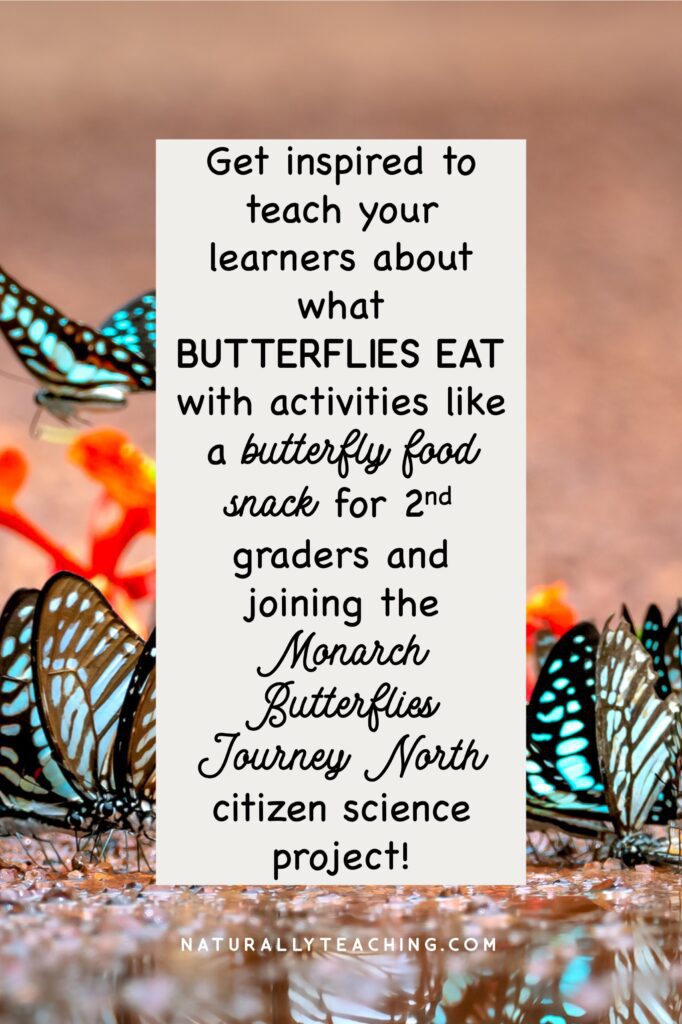
But before I explain more about the activity, let's talk about what butterflies eat. Most of us know that butterflies use their proboscis to eat nectar from flowers. It's a sugary liquid that flowers produce to entice insects to visit so that they accidentally pollinate the flower.
But they also use their straw-like mouthpart to suck up tree sap, which contains minerals and nitrogen that they need to survive, but cannot be found in nectar of flowers.
They can also be found sucking up the liquid from puddles and moist soil in search of amino acids, salts, and minerals they can't obtain from flower nectar either. Rotting fruit is another source of minerals, salts, and amino acids to balance out their diets.
Lesser known is the fact that butterflies can also be found eating rotting flesh and feces. This is an additional source of those nutrients lacking from an all-nectar diet.
So back to my idea of a butterfly food snack. As I've said before, early childhood learners learn best when they have experiences that create memories. Giving your learners a fun and memorable snack can help them experience life like a butterfly and help them better understand what a butterfly experiences.
So some thoughts for this fun snack include Kool-Aid or lemonade to represent nectar. You'll need cups, straws, and the Kool-Aid or lemonade. And if you're feeling really ambitious, you could put flower petals around the rim of your cups to remind your learners that they're enjoying “nectar”.
You could also give your learners a small taste of pure maple syrup to represent tree sap, or you could give them a little taste of sugar water if you don't have access to maple syrup.
Alternatively, you could use the secondary option I gave for the nectar. So if you choose to use Kool-Aid for nectar, you could use lemonade for tree sap. For this part of the snack, you could use small tasting spoons with the maple syrup, or you could use a small cup with the sugar water or lemonade.
For the rotting fruit, you could use pieces of fruit on a plate. You may want to clarify that they're not using the straw for this part of the snack. They should use their fingers and chew carefully.
And for the liquid from puddles, you could provide a dollop of chocolate pudding on their plate that they could use a spoon to eat. And if you really want to hit a home run, you could provide your learners some Tootsie rolls to represent feces. That would get quite a laugh.
Bring this activity full circle by reminding them how butterflies' primary food source comes from flowers and their fuzzy bodies pick up pollen when they go in for their drink. And I know this could put a strain on your budget, which is not my jam, so consider asking your families for donations to help bring this experience to life.
You could also include some outside time by considering going outside looking for butterflies using their proboscis to meet their needs. You may even see pollination in action.
[4:48]
For fifth grade, I actually pulled two Next Generation Science Standards. The first one is 5-PS3-1: Use models to describe that energy in animals' food used for body repair, growth, motion, and to maintain body warmth was one's energy from the sun and also 5-ESS3-1: Obtain and combine information about ways individual communities use science ideas to protect the earth's resources and environment.
So for fifth grade, I'm going to suggest another citizen science project. I did reference this project back in episode 15: 6 Citizen Science Projects for Elementary Students and Teachers, but it's a good one and it's easy for teachers and students to join.
I'm referring to the Monarch Butterflies Journey North project. This is a very impactful but easy to participate in project that can be done at any time of the year.
Some other butterfly or monarch specific projects can only be participated in during specific months, but this one in particular is accessible year round.
So to join this project, you, the educator, will create a free account, which you can do on the Journey North registration page, which I'll link to in the show notes.
Then take your learners outside and look for monarchs in any life stage. Or if you can't find monarchs, you can track milkweed plants. Take pictures while you're out there if you can.
Then you, the educator, takes the data and submits it, including the survey date, location, number of monarchs spotted, their behavior, and any pictures you've got.
Then you can take a look at the data that you provided to the scientific community. Super easy, super simple.
Some things to keep in mind, if you're surveying in the fall with your learners, they're looking more specifically for migration patterns, flight directions, and overnight roosting locations, if applicable.
And if you're surveying in the spring, you'll focus on finding the first monarch sighting of the calendar year, first milkweed emergence, and first egg and larvae sightings. And all of this can be found within their educational pieces.
This citizen science project connects to the physical science standard because your students are observing the milkweed plants closely for the different stages of the monarch life cycle.
And as I mentioned in last week's episode, milkweed plants are the host plant for the monarch butterfly. They're the only plants that the larval stage can eat and the only way that they can get energy for survival. And if you've already chatted about photosynthesis, your learners can surmise that the energy the caterpillars get from the plant first came from the sun.
And citizen science projects relate to the earth science standard because they help scientists learn more about the monarch populations and their overall health as a species. Scientists can only be in so many places, so by joining this project, you're helping to collect the data scientists need to get a better overall picture.
And even though it's summer, July is the time that the North American butterfly count happens, which is another citizen science project that you could partake in. If you visit their website, you can find a local butterfly count to join and help count local butterflies to help out the scientific community. Or you could even share it with your families if you're still in communication with them.
[7:50]
So in a nutshell, today we talked about activities to investigate what butterflies eat for second and fifth grade. For second grade, we talked about a butterfly food snack. And for fifth grade, we talked about participating in the Journey North Monarch Butterflies Project.
So thanks for taking time to listen today. I know you're busy and I truly appreciate the time you take to tune in. If you have any questions, wonderings, or activities to teach what butterflies eat that you use, get ahold of me on Instagram at naturally.teaching.
Or you can email me at victoria@naturallyteaching.com and don't forget to check out the show notes for this episode at naturallyteaching.com/episode80 for all those links that I mentioned.
So thanks again for joining me today. And until next time, keep exploring, keep learning, and keep naturally teaching.
Thank you so much for tuning in to today's episode of the Naturally Teaching Elementary Podcast. I hope you found it informative, inspiring, and full of actionable insights to enhance your teaching journey.
Connect with me on social media for more updates, science tidbits, and additional resources. You can find me on Instagram and Facebook at naturally.teaching.
Let's continue the conversation and share our passion for teaching elementary age children together. Don't forget to visit my website at naturallyteaching.com for all the show notes from today's episode.
If you enjoyed today's episode, please consider leaving a review on your favorite podcast platform. Your feedback helps me improve and reach more educators like you. Thank you again for listening. And until next time, keep exploring, keep learning, and keep naturally teaching.

0