![Exploring Invertebrates: 10 Picture Books to Introduce Animal Characteristics [ep. 9]](https://www.naturallyteaching.com/wp-content/uploads/2024/07/exploring-invertebrates-books-header-300x200.png)
Science
Frogs and Toads Together: Why do Amphibians Group Up?April 11, 2025

An elementary teacher science blog
Affiliate disclosure: As an Amazon Associate, I may earn commissions from qualifying purchases from Amazon.com. This is at no extra cost to you. If you’d like to learn more, check out my disclaimers page.
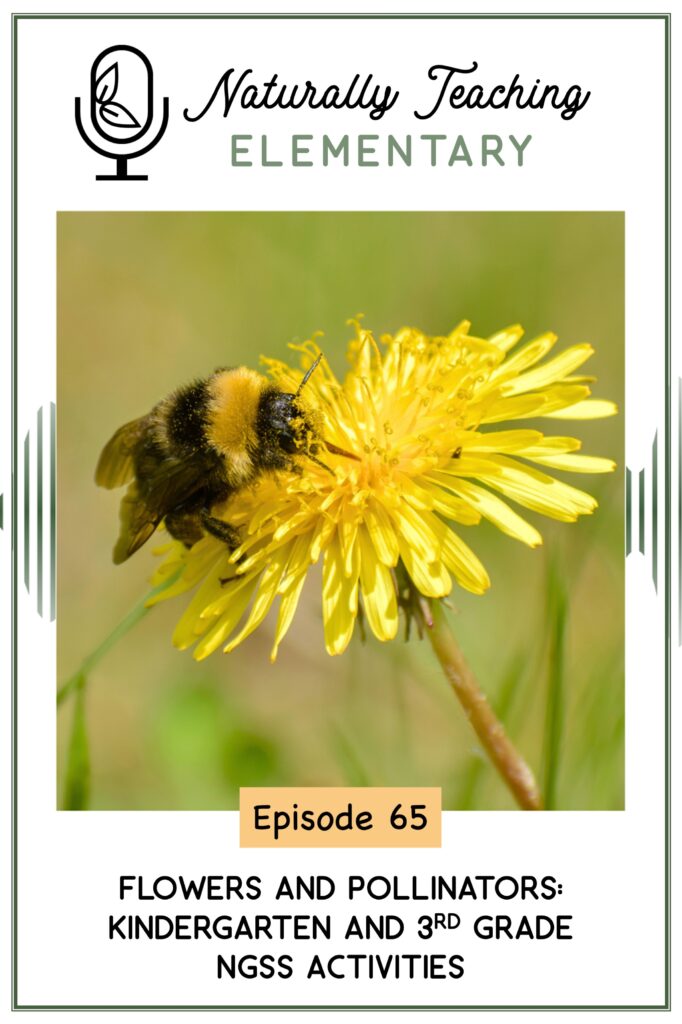
April showers bring April flowers and, with the changing of the seasons, it also brings pollinators! Now is a great time to start investigating all things flowers and celebrate the waking of the pollinators. And to get you started teaching about pollinators and flowers, I’ve got an activity idea for each grade K-5 coming at you this month.
In this episode, we’ll talk about flowers and pollinators activities that are paired with Next Generation Science Standards for grades Kindergarten and 3rd grade. I’ll share the standard that inspired the activity, how the activity relates to flowers and pollinators, and descriptions of how to use the activity with your learners.
In this episode, I discuss the following standards connected to flowers and pollinators:
Affiliate Disclosure
I only endorse things that I’ve personally used, come highly recommended by trusted peers, or I’ve done extensive research on. As an Amazon Associate, I may earn commissions from qualifying purchases from Amazon.com. This is at no extra cost to you, the commission is covered by the company.
I am recommending products that I think will be genuinely helpful and useful, and not because of the small commissions that I receive. Please only purchase items if you believe that they will help you achieve your educational goals. If you’d like to learn more, check out my disclaimers page.
[0:00]
Teaching elementary-aged children is a rewarding experience, but as educators and parents, finding the time and resources to create engaging lessons can be a challenge. That's where this podcast comes in. Welcome to Naturally Teaching Elementary.
I'm Victoria Zablocki, a certified elementary teacher turned outdoor educator. With over a decade of experience coaching teachers on effective teaching methods, I'm passionate about teaching the whole child with authentic and place-based experiences in school and home settings. Join me as we explore strategies for teaching with practical teaching tips, insightful interviews, picture book reviews, and more.
So let's grow together. All right. Welcome back to the Naturally Teaching Elementary Podcast.
My name is Victoria Zablocki and I'm your host. Last week at episode 64, I shared seven pollinator and flower books. This week, I'm excited to bring you the beginning of the flowers and pollinator activities as spring brings new flowers and the awakening of the pollinators.
So in this episode, I'm going to describe activities for grades kindergarten and third that are about flowers and pollinators. For each activity, I'll share the Next Generation Science Standard that inspired that activity as well as the scientific phenomenon that the activity helps explain. And make sure that you listen through to the end of the episode because even though I've paired these activities to particular standards, you may find yourself inspired to use a similar concept for your curriculum or even use the same activity for a different grade.
Also, if you're new to taking your students outside for learning, check out episode 6: 5 Outdoor Education Safety Tips for Teaching Outside for suggestions to make teaching outside easier. Now let's get into these activities about flowers and pollinators.
[1:38]
So for kindergarten, the Next Generation Science Standard that I pulled was K-LS1-1: Use observations to describe patterns of what plants and animals, including humans, need to survive.
So for kindergarten, I suggest doing a plant study using your learners' prior knowledge and experiences coupled with new observations. So to do this, have them think back to winter and what they remember about plants. Do they recall seeing any plants during wintertime?
Work with your learners to record what they remember. Talk about winter weather, too. What was the weather like during the winter season?
Record their recollection of the weather conditions as well. And if you're in the northern part of the U.S. that gets snow, your kindergartners probably won't remember very many plants. Or if they do, they may remember trees.
Talk about what trees looked like during the wintertime. Did they have leaves? Did they have needles? Do they remember seeing any other plants?
If you're in the southern part of the US where plants grow year round, though, this part of the study may be a little trickier, but it's still doable. Have them describe what they remember about plants and maybe focus more on the presence or lack of presence of flowers rather than naked plants like you'd see in the north.
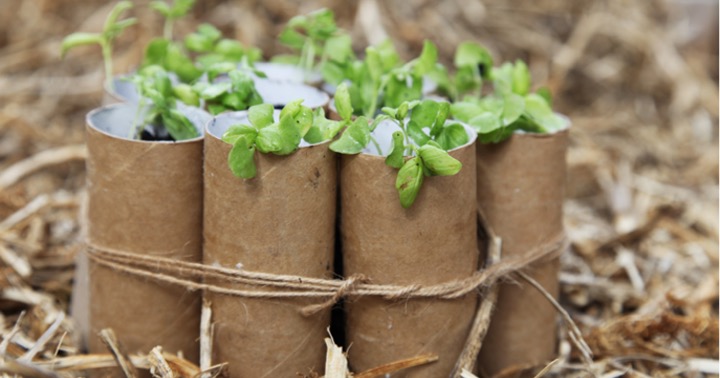
The next part of the study is to take time once or twice a week to go outside and look for new growth. You may see flowers blooming in your flower beds that weren't there the week before, or maybe the grass is looking fuller and greener, or maybe dandelion flowers pop up in your green space. Have your learners record the weather conditions that they're experiencing now as well.
Once you've taken multiple opportunities to go outside, and you've observed new growth, and you've recorded the weather of spring, have them try to surmise what plants need to grow. Why didn't they see plants growing in the winter, or why didn't they see as much new growth during the wintertime? From their observations, what do they think that plants need in order to grow?
If they're struggling answering this question, you could work together as a group to make a double bubble chart, Venn diagram, or use another graphic organizer to compare winter to spring and the amount of plant growth in each season. Hopefully, from their observations, they can gather that plants not only need sun, which they can get all year round, they also need water, warmth, and thawed soil.
[3:52]
For third grade, the Next Generation Science Standard that I pulled was 3-LS1-1: Develop models to describe that organisms have unique and diverse life cycles, but all have in common birth, growth, reproduction, and death. For third grade, I'm going to suggest doing a pollinator live stage BioBlitz. But before you get into the actual BioBlitz, consider reading Not a Buzz to Be Found: Insects in Winter by Linda Glaser, illustrated by Jaime Zollars.
Unfortunately, it's a book that's no longer being printed, but if you can get your hands on it, it's a great illustration of insects and how they survive winter. And the wonderful thing is that insects actually survive winter in a variety of life stages, providing your learners the opportunity to find insects as eggs, larva, pupa, or adults in the spring as the weather turns. And reading this book before your BioBlitz will give your learners some background knowledge about the different life stages they might be able to find and where they might find them in your green space.
Now, going back to the idea of a BioBlitz, if you have never heard of a BioBlitz before, I described what they are in episode 63: Frogs vs Toads and Other Herps in Spring: Kindergarten through 5th grade Next Generation Science Standard Activities. But to give you a quick idea, a BioBlitz is defined as a fast-paced community-driven event where scientists volunteers and nature enthusiasts work together to identify as many species of plants, animals and fungi as possible within a designated area and time period, typically 24 hours.
And since you likely don't have scientists, other volunteers, or 24 straight hours, we're going to modify this definition a little bit. What I'll suggest for you and your learners is that you pick up Friday afternoon or the last day of the week and spend the last hour or two running your BioBlitz, depending on how much green space you have to survey. If you hype it up right, your kids will look forward to this and will come with a lot of energy.
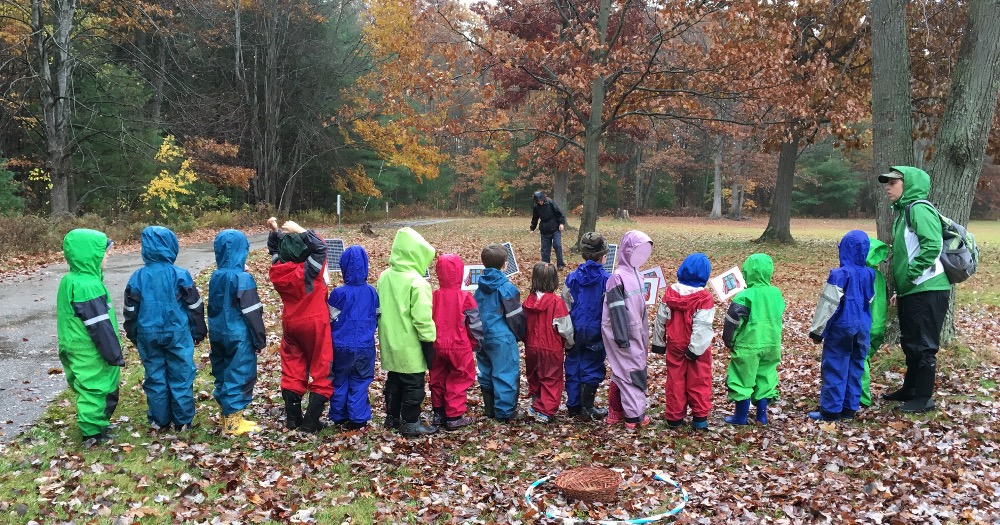
And that being said, your future self would be very grateful that you had the forethought to put this activity at the end of the day, at the end of the week. Once you've picked your day, you'll want to help your learners be as successful as possible, meaning you're going to want to split them into more than just one group. So to do this in a classroom setting, you'll want to ask for caregiver volunteers that can move with smaller groups of learners in your school's green space.
If you're a homeschool parent, you already have a small group and will likely be able to do this solo. If you're a homeschool co-op coordinator, you'll want to make sure that caregivers stick around for this activity so that you can have smaller groups of learners. Next, you'll want to make sure you're continuing to set your learners up for success by having different identification options for them.
Do you have field guides that you could send with each group? Do you have iPads that they could take pictures and possibly use the Seek app? Do you have quick ID cards that you could provide each group?
Helping your students have supports to identify what they're finding will help them develop their research skills while also supporting their ability to collect data. And you should also consider if you'd like your learners to identify as far as species or if you'd prefer that they identify them simply as an egg, larva, pupa, or adult. This way of identifying would speak more toward the life stage part of this standard and would probably make the identification process of the BioBlitz less intimidating.
Trust me, I've been in outdoor education for 13 years and the idea of IDing every insect down to species is very overwhelming to me. Then you'll have to determine how you'd like to collect the BioBlitz data. Do you want to provide an anchor chart paper with a table on it that the kids add their observations to?
Do you want them to post their observations to iNaturalist? Do you want them to record their observations on a group sheet and then report back at the end of the time? This part is really up to your preference and discretion.
Each method has pros and cons. Once you've decided on the logistics, share them with your learners. These rules and regulations will help them do their best to locate and record different pollinator life stages on your Bioblitz day.
This activity will help your third graders see that pollinators exist in different life stages throughout the year and that they can find evidence of actual individuals that belong in the egg, larva, pupa and adult life stages. Many pollinators come in the four different full metamorphosis life stages. That's really unique and special. You can celebrate that with the specialized Bioblitz.
[8:10]
Today we talked about flowers and pollinator activities for kindergarten and third grade. For kindergarten, we talked about a plant seasonal study.
For third grade, we talked about a pollinator life stage Bioblitz. If you're looking for more ideas for teaching about flowers and pollinators, check out my article “Pollination for Plants: How to Use Flowers or Calling for Effective Teaching” on naturalleteaching.com, or you can follow the link in the show notes. So, thanks for taking time to listen today.
I know you're busy and I truly appreciate the time you take to tune in. If you have any questions, wonderings, or flowers and pollinator activities that you use, get ahold of me on Instagram at Naturally.teaching, or you can email me at victoria@naturallyteaching.com. And don't forget to check out the show notes for this episode at naturalleteaching.com/episode65 for all those links that I've mentioned.
So thanks again for joining me today. And until next time, keep exploring, keep learning, and keep naturally teaching. Thank you so much for tuning in to today's episode of the Naturally Teaching Elementary Podcast.
I hope you found it informative, inspiring, and full of actionable insights to enhance your teaching journey. Connect with me on social media for more updates, science tidbits, and additional resources. You can find me on Instagram and Facebook at naturally.teaching.
Let's continue the conversation and share our passion for teaching elementary-aged children together. Don't forget to visit my website at naturallyteaching.com for all the show notes from today's episode. If you enjoyed today's episode, please consider leaving a review on your favorite podcast platform.
Your feedback helps me improve and reach more educators like you. Thank you again for listening, and until next time, keep exploring, keep learning, and keep naturally teaching.

0