
Science
Frogs and Toads Together: Why do Amphibians Group Up?April 11, 2025

An elementary teacher science blog
Affiliate disclosure: As an Amazon Associate, I may earn commissions from qualifying purchases from Amazon.com. This is at no extra cost to you. If you’d like to learn more, check out my disclaimers page.
August is time for going back to school and I’m spending the month sharing ways that you can set you and your learners up for success. Picture books are a great integration to your first week activities because they can be used to set up routines and expectations, they can reach your learners in a very unique way, and they can help you save time in your teaching.
In this episode, I share 7 picture books for going back to school. Listen in to discover some amazing picture books that can lead to outdoor exploration, stewardship conversations, and new perspectives!
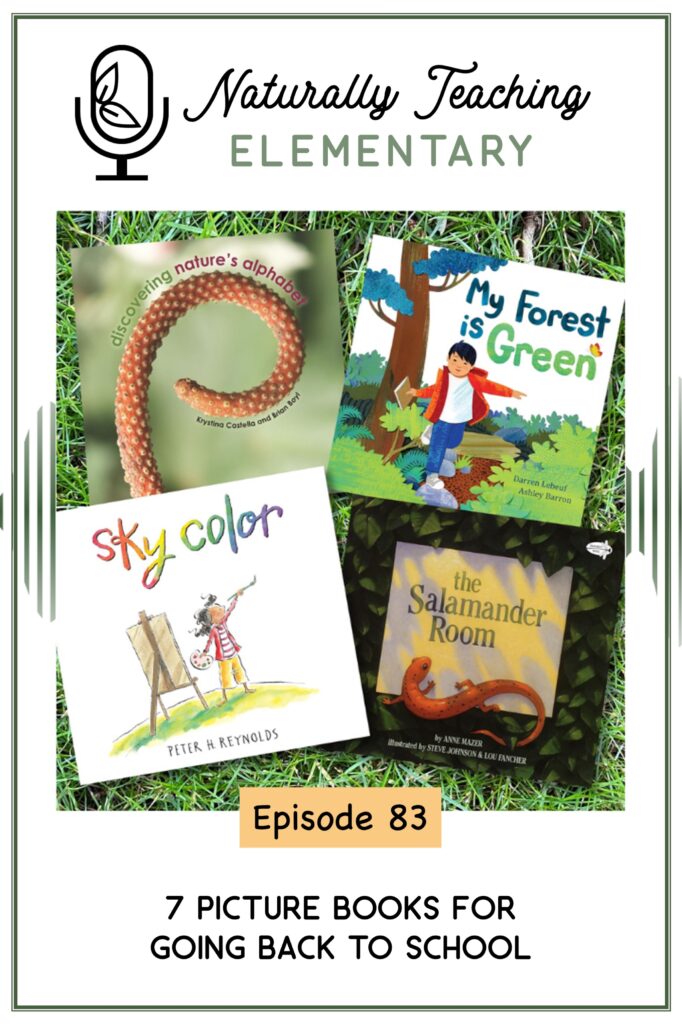
Going back to school books covered in this episode include:
Want to view all of these in one place? Check them out here!
Affiliate Disclosure
I only endorse things that I’ve personally used, come highly recommended by trusted peers, or I’ve done extensive research on. As an Amazon Associate, I may earn commissions from qualifying purchases from Amazon.com. This is at no extra cost to you, the commission is covered by the company.
I am recommending products that I think will be genuinely helpful and useful, and not because of the small commissions that I receive. Please only purchase items if you believe that they will help you achieve your educational goals. If you’d like to learn more, check out my disclaimers page.
[0:00]
Teaching elementary-aged children is a rewarding experience, but as educators and parents, finding the time and resources to create engaging lessons can be a challenge. That's where this podcast comes in. Welcome to Naturally Teaching Elementary.
I'm Victoria Zablocki, a certified elementary teacher turned outdoor educator. With over a decade of experience coaching teachers on effective teaching methods, I'm passionate about teaching the whole child with authentic and place-based experiences in school and home settings. Join me as we explore strategies for teaching with practical teaching tips, insightful interviews, picture book reviews, and more.
So let's grow together. Hey everybody, welcome back to the Naturally Teaching Elementary podcast. My name is Victoria Zablocki and I'm your host.
So the first week of school is just around the corner, or for some of you, it's literally this week. I've been sharing ideas this month to help you feel less overwhelmed by the beginning of the year, and hopefully today we'll add some great picture books to your beginning of the year toolkit. Why picture books?
I'm a firm believer that picture books can reach our learners in a way no other medium can. They can impart knowledge while also sharing social stories. They can tap into the creative side of children while also being used as a reference for truth.
They can help you share a solution to a problem or simply be used to break up the day. They are truly an amazing tool that don't get the praise they deserve. To help you, the teacher or homeschool parent, find some great books for going back to school, I put together a list of seven beginning of the year books that provide you pictures and text to ease your learners back into the swing of things.
For each book, I'll share a summary of the storyline and also how I think you could use it for going back to school. And if you've listened to my other episodes about picture books, I'm sure you've caught on to the fact that I'm very passionate about teaching science concepts with the help of children's literature. And for good reason.
Research has shown that integrating science and literacy has many benefits, including saving teachers' time in their schedule, improved attitudes of children towards science, better overall performance in reading and science, and so many more. For more information about benefits and methods for integrating science and literacy, check out my blog post, Teaching with Books: How to Integrate Science and Literacy for Elementary Classrooms. So let's get into these picture books for going back to school.
[2:18]
So book number one is “Let's Go Rock Collecting” by Roma Gans, illustrated by Holly Keller. This book is a nonfiction book about rocks, where they're found and how they're made. It's mostly an illustrated book, but there are pictures of rock samples within the book, including granite, quartz, basalt, gneiss, limestone, sandstone, marble, quartzite, and the Mohs scale of hardness.
There are explanations for igneous, sedimentary, and metamorphic rocks as well. And the story ends with an invitation to go out and find rocks near you. This is a great book to encourage your learners to look closely at nature and to start finding different kinds of rocks.
You could use this book in your first week to get your learners outside, looking closely at rocks for different shapes, colors, or textures. It's an easy entry activity to getting your learners involved with nature education because there are rocks everywhere and they can help you start having wonderful conversations with your learners.
[3:09]
Book number two is “The Salamander Room” by Anne Mazer, illustrated by Steve Johnson and Lou Fancher. This is a book about a boy named Brian who brings a salamander into his room. His mom warns him that his room doesn't have the things the salamander needs to survive, so Brian takes it upon himself to bring inside the things that the salamander needs.
He gives the salamander a bed made out of leaves and moss, wet leaves and stumps for the salamander to play on, other salamanders for it to play with, insects for the salamanders to eat, and birds and frogs to eat the extra insects, and more.
This book is a great introduction to stewardship and animal needs. It's important to talk about taking care of nature at the beginning of the school year, and this book addresses that beautifully. Ultimately, your learners will see that even though Brian provided all the things the salamander needs, it's really not feasible to have a salamander live in your room.
This can lead to great conversations about leaving nature in nature for its safety and growth. A very important lesson to learn at the beginning of the school year.
[4:08]
Book number three is “We're Going on a Nature Hunt” by Steve Metzger, illustrated by Miki Sakamoto. This book is loosely based on the popular book “Going on a Bear Hunt” and uses a similar repetitive style to get learners to chime in with predictable storyline. But in this book, Metzger uses a nature exploration adventure to find different things in nature including wildflowers, frogs in a pond, worms in the ground and eggs in a nest. Metzger also encourages stewardship with reminders of how to keep nature safe, like not picking the flowers, not scaring the frogs, not hurting the worms and not touching the robin eggs.
This can be a great invitation for exploring nature in the first week of school. Because of the familiar cadence of the story and the use of rhyme, this book will hook early childhood learners and can introduce your connection to outdoor learning, integration of literacy in your science studies and nature stewardship. And if you like this book, Steve Metzger and Miki Sakamoto also have a book called “Going on a Leaf Hunt” that you could use in the fall.
[5:06]
Book number four is “The Hike” by Alison Farrell. This book is told through speech bubbles and sporadic story line sentences. They work together to share the different stages and excitement that come from going on a hike such as running like maniacs, finding something that slows you down, finding something that gets you to observe nature closely, finding space to explore, having experiences that build your confidence, and experiencing the wonder of nature.
The book ends with a peek into Wren, one of the characters' sketchbook with drawings and notes from their experience. This is another option for an invitation to explore nature at the beginning of the year. The activities in this book are examples for a loose exploration-based hike, and can be a great way to ease your learners into using nature in your curriculum.
I love the addition of Wren's notebook through the storyline and the lessons that are taught from each of the different kinds of activities that they do together on their hike. I would point out though, that you want to make sure that you're following your school or family's rules on eating what you find in nature. Some schools and homeschool families feel equipped to add foraging to their curriculum, but if you're not a confident forager, please omit that part of the exploration.
It's also hard to teach children that you can eat some things in nature, but not all things. Also, it's hard to know if there were any chemicals added to berries or other edibles, and you want to keep your learners explicitly safe. I love the extra labels throughout the pictures as well. This book can work as an invitation for exploration, but also as a reference for what can be found in nature. Plus, there are children of minority pictured in this book, which is great to have diversity within our pictures as well.
[6:39]
Book number five is “My Forest is Green” by Darren Lebeuf, illustrated by Ashley Barron. This book is about a boy who lives in a city, but visits a forest amongst the traffic and buildings. He likes to keep record of what he sees in the forest with drawings, paintings, collections, and other creative expressions. He uses a lot of descriptive words to share about his forest, including tall, short, fluffy, prickly, rough, smooth, wide, narrow, heavy, light, big, small, dense, sparse, crispy, soft, snowy, wet, scattered, soggy, spotted, foggy, green, and many other colors.
On each spread, you can see him creating his creative representation of records of his forest, and you can see different natural occurrences and the changing of the seasons throughout the storyline. This is another great option for an invitation to explore nature, but more focused on a creative interaction that brings calm and a feeling of belonging. This book is a great introduction to how you can interact with nature in a different kind of way.
A lot of times we think of collecting things, or we think of observing, but this is a way of keeping record of what you find in a creative and interesting way. It could work as a great first option to introduce science notebooking in your classroom, and it could encourage more exploration. It could also encourage some of those kiddos that find writing to be a task to actually get involved in their scientific notebooking.
[8:04]
Book number six is “Sky Color” by Peter H. Reynolds. This book is about a girl named Marisol that is an artist. She loves to paint and her class was assigned to paint a mural for the library. Everyone started shouting out what they wanted to paint, and Marisol decided to paint the sky. But there wasn't any blue paint in the paint box, and she wondered how she would paint the sky without any blue.
Then as she was going home, she noticed that the sky was not blue as the sun went down, and the next day when it was raining, it was also not blue. Then she had an idea and painted the sky in a mural, a new color that she called sky color. This quick and easy read is a great reminder to our students that not everything is as it seems.
Most children would assume the sky would need to be painted blue, but some observation showed that that wasn't the case at all. This could be a good option to share with your kiddos to encourage observation as well as out of the box thinking at the beginning of the year. And this book also has a child of minority as the main character, which again is great for children to be able to see themselves in storylines.
[9:05]
Book number seven is “Discovering Nature's Alphabet” by Krystina Castella, illustrated by Brian Boyl. This book is an alphabet book where each of the letters is a picture of different parts of nature. The author invites their readers to slow down and explore in order to find different letters in nature.
She also shares that perspective can make a letter hide until you get into the perfect position. Some examples of nature that were pictured include lily pads, holes in the ground, leaves, flower petals, sticks, thorns, shadows, rocks, trees, aquatic plants, animals and more. This book is a fun way to approach a first trip into nature this school year. You could read this book and then go outside looking for examples of the alphabet in the green space around your classroom or home.
[9:49]
So in a nutshell, today we talked about seven picture books for going back to school. Titles that were summarized include “Let's Go Rock Collecting” by Roma Gans, illustrated by Holly Keller, “The Salamander Room” by Anne Mazer, illustrated by Steve Johnson and Lou Fancher, “We're Going on a Nature Hunt” by Steve Metzger, illustrated by Miki Sakamoto, “The Hike” by Alison Farrell, “My Forest is Green” by Darren Lebeuf, illustrated by Ashley Barron, “Sky Color” by Peter H. Reynolds, and “Discovering Nature's Alphabet” by Krystina Castella, illustrated by Brian Boyl.
So thanks for taking time to listen today. I know you're busy and I truly appreciate the time you take to tune in. If you have any questions, wonderings or books you use for going back to school, get a hold of me on Instagram at naturally.teaching, or you can email me at victoria@naturallyteaching.com. And don't forget to check out the show notes for this episode at naturallyteaching.com/episode83 for all the links that I've mentioned. So thanks again for joining me today, and until next time, keep exploring, keep learning, and keep naturally teaching.
Thank you so much for tuning in to today's episode of the Naturally Teaching Elementary Podcast. I hope you found it informative, inspiring, and full of actionable insights to enhance your teaching journey.
Connect with me on social media for more updates, science tidbits, and additional resources. You can find me on Instagram and Facebook at naturally.teaching. Let's continue the conversation and share our passion for teaching elementary age children together.
Don't forget to visit my website at naturallyteaching.com for all the show notes from today's episode. If you enjoyed today's episode, please consider leaving a review on your favorite podcast platform. Your feedback helps me improve and reach more educators like you.
Thank you again for listening and until next time, keep exploring, keep learning, and keep naturally teaching.

0